
Intro
Defence Procurement is high on the European Union’s agenda and connected with the Union’s geopolitical, strategic and geo-economic priorities. Many initiatives and instruments (see Defence Omnibus) aimed at facilitating defence investments, strengthening the European defence industrial capabilities and incentivising cooperation among Member States are in full swing. The Council Presidency and the European Parliament’s negotiators reached a provisional agreement on the 10th of June 2026 regarding the next steps. These steps envisage also the reform of the EU defence procurement regulatory framework including the Directive Defence and Security Procurement 2009/81/EC (DSPD) (see Commission’s Proposal).
Although the proposal contains some useful adjustments for fine-tuning the existing legislative framework, it fails to reflect upon a key parameter: The fundamental assumptions and premisses upon which the framework is based.
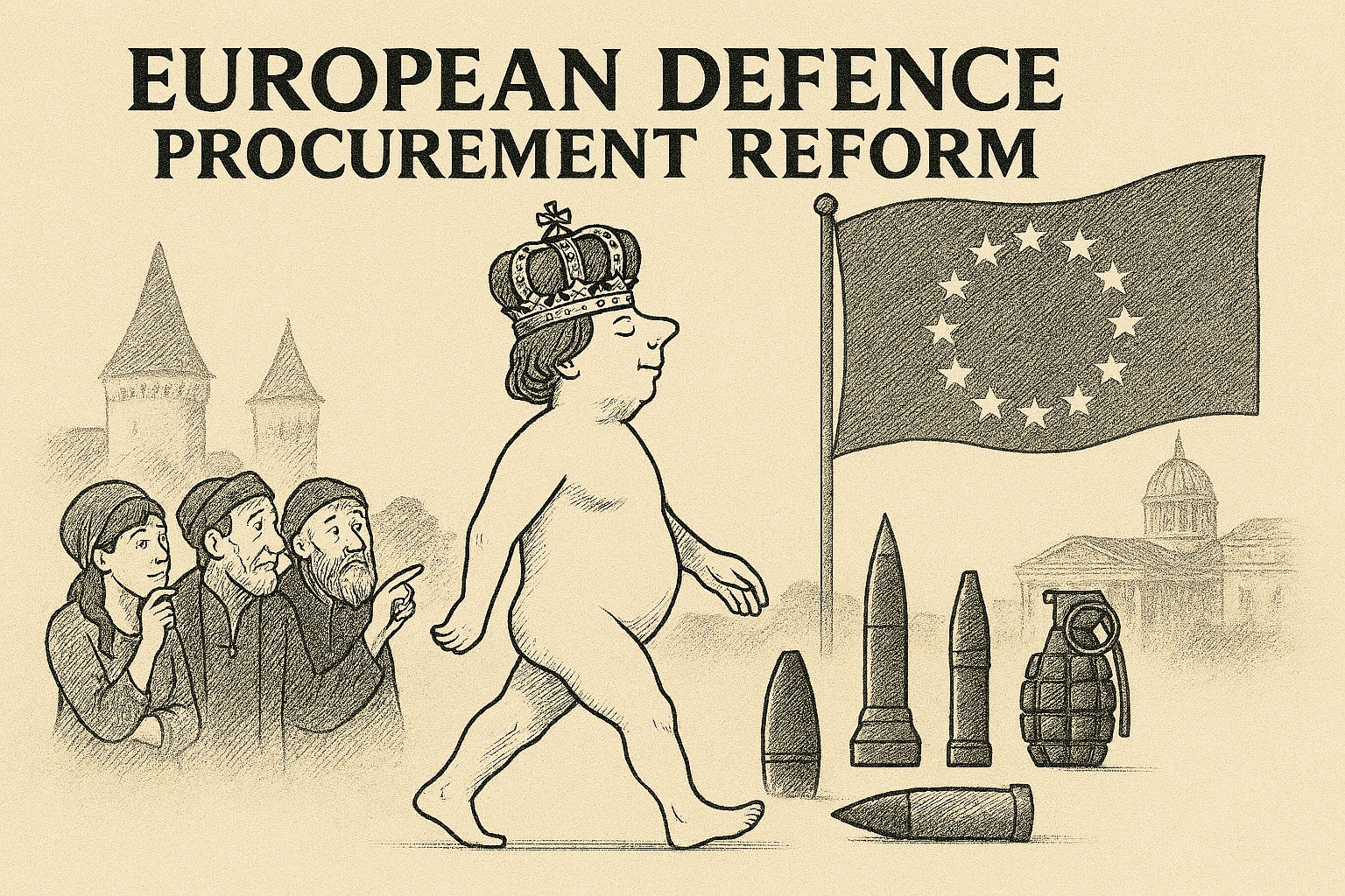
The present post, which roughly corresponds to my contribution to the consultation process of the European Commission for the simplification of the rules on defence and security procurement (all the submitted contributions can be accessed here) aims to challenge some of these assumptions, call out aspects of the current policy/regulatory approach which have proved counterproductive and highlight some potential alternative options for further consideration. In other words it follows the message/example contained in Hans Christian Andersen’s fairytale “The Emperor’s New Clothes” (hence the title) hoping to trigger a meaningful and productive debate.
“Although the proposal contains some useful adjustments for fine-tuning the existing legislative framework, it fails to reflect upon a key parameter: The fundamental assumptions and premisses upon which the framework is based”
Rethinking the Fundamentals
The war in Ukraine functioned as a waking-up call and a reminder of a simple fact: Contrary to the narrative that had been promoted previously in the run up to the adoption of the defence package in 2009, the defence market is not like any other market. This is an important point that needs to be underlined in an honest fashion.
This also means that the creation of instruments and more importantly the application of such instruments purely from an “internal market logic” is bound to be of limited impact and often become counterproductive. The enactment of the Defence and Security procurement Directive was based by and large on this logic. It is what I call the “internal market- competition paradigm”.
The inherent weakness of this approach has been demonstrated by the limited use of the framework for the important defence procurement contracts of European Member States since its enactment.
“Had this regulatory regime been used and “religiously” enforced, as perhaps the pure internal market logic and rationale of the latter was intending, many of the industrial production lines, which were called to respond at short notice and shoulder the production of missiles and munition for Ukraine and/or to replenish the stocks of EU Member States …., they would not have been “alive” to fulfil this mission; they would have vanished years before, victims of a relentless process of market Darwinism.”
Furthermore, there is another even more important observation that highlights the limitation of this paradigm: Had this regulatory regime been used and “religiously” enforced, as perhaps the pure internal market logic and rationale of the latter was intending, many of the production lines, which were called to respond at short notice and shoulder the production of missiles and munition for Ukraine and/or to replenish the stocks of EU Member States, they would not have been “alive” to fulfil this mission; they would have vanished years before, victims of a relentless process of market Darwinism.
It is worth pointing out clearly that once these industrial capabilities are gone and their workforces forced to reskill (in order to find employment in other sectors of the economy), it is impossible to quickly summon them back to life when the need arises. For this reason defence/security industrial capabilities need to be maintained and supported even during the “lean cows” years of defence spending. Applied strictly during the “peace dividend” years, a defence procurement framework, which is based purely on an “internal market- competition paradigm”, would lead mathematically to the loss of industrial capabilities and of technical knowledge, which may be needed in the future at short notice.
From the point of view of desired security and EU autonomy outcomes/capabilities the defence and security market has more similarities with Common Agricultural Policy than the traditional internal market. Such “reframing” allows us to approach the defence and security market in a more realistic way which can lead to more productive and useful solutions.
Therefore when relevant consultations frame the questions along the lines “how can the EU defence procurement rules and the directive be applied more frequently,” they may unwittingly do a disservice by setting the discussion on a path with counterproductive outcomes for the defence and security of the EU and its Member States.
“Applied strictly during the “peace dividend” years, a defence procurement framework, which is based purely on an “internal market- competition paradigm”, would lead mathematically to the loss of industrial capabilities and of technical knowledge, which may be needed in the future at short notice”
These observations do not suggest that the enactment and operation of the defence and security procurement directive serves no purpose. On the contrary it provides a useful framework which if fine-tuned could facilitate, together with other complementary initiatives, the achievement of the desired results.
“…when consultations … frame the question along the lines “how can the EU defence procurement rules and the directive be applied more frequently,” they may unwittingly do a disservice by setting the discussion on a path with counterproductive outcomes for the defence and security of the EU and its Member States.”
Some Food for Thought
For example one of the key findings of assessments of the Defence and Security Directive (here and here) was the difficulty of lower tier companies and SMEs to enter in the supply chains of European Primes (major defence contractors) when they (the SMEs) are established in Member States where no such major contractors are based. This lead the Member States where these SMEs are based to use either Article 346 TFEU or one of the Directives exemptions, usually the Government to Government (G2G) exemption (Article 13 (f) DSPD) which allowed such companies to enter in the supply chains of defence primes, more often than not established outside the EU, mainly in the United States.
The solution to this problem (the problem being, the difficulty of lower tier companies and SMEs to access and enter in the supply chains of European primes; ….not the frequent use of the exemptions…) is not the stricter enforcement or more narrow interpretation of these exemptions. This approach would be counterproductive. On the contrary the EU internal market ought to consider more “outside of the box” solutions.
One such approach would be a more honest and realistic legal treatment of industrial participation agreements (otherwise known as “offsets”; a terms which carries negative connotations).
The “purist” internal market approach of the guidance on offsets of the European proved counterproductive. Whereas the European Defence Agency’s Code of Conduct on Offsets, convinced, for the first time, Member States to speak speak more openly about these national policies with the aim of finding ways to mitigate in the future their perceived negative effects, the approach of the European Commission to consider them a priori a “biblical sin” of the internal market, led Member States and their policies back to the proverbial shadows (as I had explained here).
A more realistic and organised approach towards industrial participation agreements is necessary. The “subcontracting” provisions of the European Defence Directive -which had been highlighted as a substitute- as they stand and interpreted constitute more a red hearing than a meaningful tool which will help European SMEs.
There are possible ways for proceeding to a more realistic regulation of industrial participation agreements at EU Level (some of which I had discussed in my PhD Thesis A. Georgopoulos European Defence Procurement Integration: Proposals for Action within the European Union (PhD Thesis) p. 344 et seq.) and will be presented in future posts and publications in more detail.
“Continuing to pretend that the defence market is like any other market is a luxury Europe cannot afford.”
Hans Christian Andersen’s fairytale “The Emperor’s New Clothes” contains a number of important and didactic messages. A key one relates to the Emperor’s response once he realises the truth following the reaction of the child and crowd: too proud to admit that he has been deceived, marches on accompanied by his entourage who also pretend that everything is fine and continue to “carry” the non-existing imperial mantle.
Continuing to pretend that the defence market is like any other market is a luxury Europe cannot afford.
#EUDefence #EDTIB #DefenceProcurementDirective #Article346 #industrial_participation #offsets #G2G #DefenceProcurement, #StrategicProcurement #InnovationProcurement #DefenseProcurement #EUDefenceOmnibus #arisoflawxley #arisgeorgopoulos
Twitter: https://twitter.com/arisoflawxley
Facebook: https://www.facebook.com/arisoflawxley/
@arisoflawxley

